

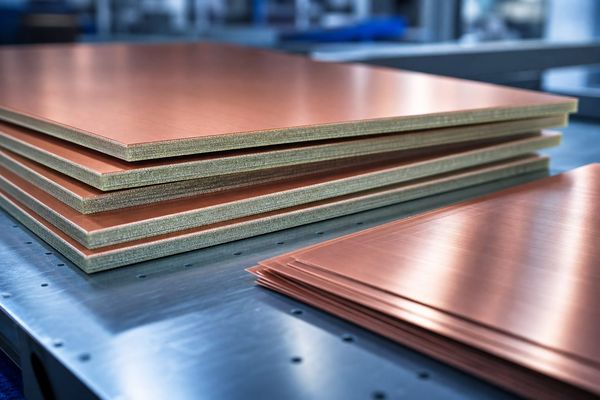
The printed circuit board industry is currently experiencing a serious raw-material shortage: the core substrate that every PCB is built on, copper clad laminate (CCL), has become significantly more expensive and harder to source on short notice.
What is copper clad laminate?
Copper clad laminate is the base material of a printed circuit board. It is made by bonding a thin layer of copper foil onto an insulating core of glass-fiber cloth impregnated with resin (the familiar FR4 being the most common). Almost every board produced begins as CCL, and the thin resin-coated sheets used to bond multilayer stacks (prepreg) come from the same supply chain. When copper clad laminate supply tightens, it affects PCB availability and pricing "across the board", not just exotic or high-end designs.
Why PCB prices are rising
The dominant driver is the rapid build-out of AI computing infrastructure. Data centers for AI workloads need far more high-performance laminate per system than traditional computer hardware, and demand for these premium grades has grown faster than material makers can expand their capacity.
The bottleneck in serving this demand is due to specialized inputs, including low-loss "low-Dk" glass fabrics (often called T-glass), high-grade copper foil, and specialty resins. Because large buyers are reserving capacity in advance, manufacturers are shifting production lines toward these premium materials, which thus reduces the capacity available for standard grades. This then trickles down even to ordinary FR4 buyers with higher prices and longer lead times.
Two additional factors are putting further pressure on the already challenging situation. Copper is a major share of a laminate's raw-material cost, and copper foil prices have themselves been rising. On top of that, regional conflicts (e.g. Iran) are affecting the supply of resins and copper, which add even more uncertainty to an already tight market.
What we are seeing on price and lead times for PCBs
Industry reporting through the first half of 2026 has been consistent in sounding the alarm:
- Independent trade data saw South Korean copper clad laminate prices at record levels in early 2026, up more than 70% year over year. 2026 was the first year on record that saw prices exceed USD 20,000 per metric ton.
- Major laminate makers have issued multiple price increases in the first half of 2026, with high-end grades seeing the steepest adjustments of roughly 20% to 40%.
- Copper foil, a key copper clad laminate input, has risen sharply since the start of the year.
- Lead times for standard copper clad laminate and prepreg that were a few weeks a year ago are now routinely quoted in months, and high-speed or high-frequency specialty materials run considerably longer.
These are broad market trends rather than a single set of figures. The practical takeaway here is that both price and availability are moving in the wrong direction, and quotations are valid for shorter periods than customers have been used to.
How long could this last?
This is a structural shortage in the PCB supply chain rather than a short-lived spike, so a quick return to previous pricing is unlikely. Capacity expansion is in progress, with several major suppliers building new laminate plants, but new capacity takes time to come online, and these new fabs are not expected to reach mass production before 2028. General consensus in the industry is that the PCB situation will remain tight, with meaningful relief unlikely before 2028. We will keep monitoring the market and update this guidance as conditions change.
What this means for our customers
For most prototypes and smaller runs, availability is not an immediate concern, though it increasingly comes at a higher price. For series production or longer-running projects, planning with blanket purchase orders and/or forecasts is the single most effective way to protect both your timeline and your budget.
Our recommendations
- Plan and forecast early. Share your expected volumes for the coming quarters with us so we can secure material ahead of demand. During shortages, orders placed earlier are served first.
- Refresh older quotes. Material pricing from previous years is no longer achievable, so budgets and quotations should be reviewed against current costs.
- Consider safety stock. For critical products, we can hold strategic stock of boards or materials on your behalf to minimize delivery risks.
- Review your stack-up. Where a design does not truly require premium high-speed laminate, a hybrid or standard stack-up can reduce reliance on the scarcest, most expensive materials.
Newmatik maintains a broad international network of audited PCB and material partners and works closely with them to keep capacity secured for our customers. If you would like to review your upcoming requirements or discuss a sourcing strategy, our team is always happy to help.