

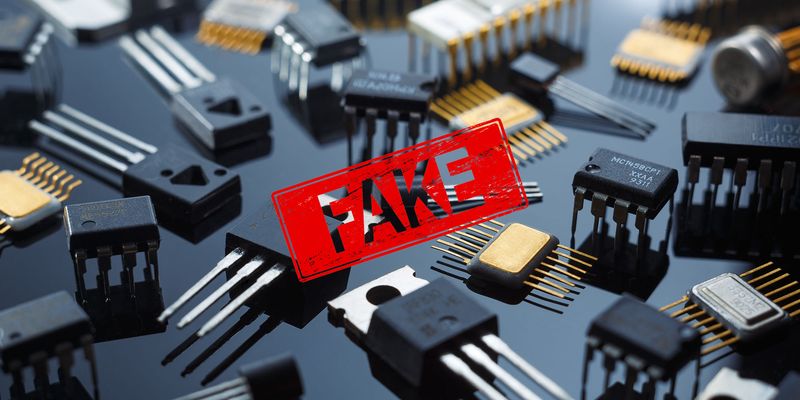
The Problem: Counterfeit ("Fake") Parts
In the electronics industry, counterfeit ("fake") parts and refurbished parts are unfortunately a continuing risk for the supply chain, especially when purchasing outside of standard distribution channels. The most commonly counterfeited parts are analog ICs, microprocessors, memory ICs, programmable logic ICs, and transistors.
Parts that are obsolete, expensive, or in short supply are especially susceptible to being counterfeited. Counterfeit parts are not only a violation of the manufacturer’s intellectual property: they also may not work correctly or at all, jeopardizing the functionality and even safety of the end product into which they are assembled.
Due to short lifecycles of consumer electronics, many devices are scrapped within a few years. This has opened up a market for refurbished parts, which are defined as electronic components that have been taken off assembled circuit boards, cleaned, and then sold as new and original.
OEMs and EMS companies have responded by implementing counterfeit prevention programs and creating new test methods and standards for detecting counterfeit parts. But the problem remains.
Inspection Checklist for Electronic Components
If purchasing electronic components outside of your normal supply chain, here are some important guidelines to follow in the preliminary visual inspection:
First Impressions
- Are the parts clean, free of scratches, sanding, whiskers, or dirt?
- Is the packaging in good condition, free of dents, cuts, warping, cracks, or any other damage?
- Is there discoloration on the packaging itself indicating improper storage or aged labels?
Packaging of Electronic Parts
- For components that are particularly susceptible to ESD (semiconductors such as IC, memory, transistors, diodes, etc.): were the parts shipped in ESD-compliant packaging?
- Does the information on packaging from the manufacturer or supplier (e.g. labels, reels, boxes) match the part number of the component?
- Are the parts packaged in a consistent way? Is the packaging typical of the manufacturer, or does it appear to come from a third party?
- Are the seals on the packaging original? Have the seals on the packaging been broken and re-sealed?
- Is the seal date on the packaging consistent with the date code? (The seal date should only be on or after the date code.)
- Do the factory codes or countries of origin match the manufacturer's publicly available information (product change notifications, etc.)?
- Is the manufacturing date code logical (e.g. a part that was discontinued in 2013 cannot have a date code of 2017)?
Visual Inspection of Electronic Parts’ Physical Characteristics
- Does the part have the correct dimensions and/or number of pins, as defined in the manufacturer’s data sheet?
- Is product information such a part number, date code, lot code, and country of origin the same on the top and bottom of the component?
- Do the surfaces and edges of the parts look the same on the top and bottom? (If not, the parts may have been altered or painted. Microscope inspection may be required here.)
- Are the manufacturers’ logo and/or markings on the packaging and/or part itself consistent with the manufacturer’s corporate design?
- Do all parts have consistent part markings? (Markings that are not uniform in color, font, or texture may have been altered.)
- Are any leads and/or pins discolored or oxidized? Do any leads and/or pins have excess metal on them? (Pins that appear very shiny may have been re-tinned.)
- If the part has a “pin one” indication, is this located in the same position on all parts?
- If the part has a mold cavity, it should be clean and smooth in appearance. (If not, they may have been resurfaced, filled in, or coated.)
Beyond the visual inspection as described in this checklist, parts may also be inspected using X-ray or X-RF inspection, burn-in testing, decapsulation, scanning acoustic microscopy, acetone testing, or parametric testing. In addition to these measures, parts can be tested for their electrical function or solderability to help guard against counterfeits.
You can and should ask your suppliers what protocols they follow to inspect their components and ensure that counterfeit parts do not make their way into their supply chain.