

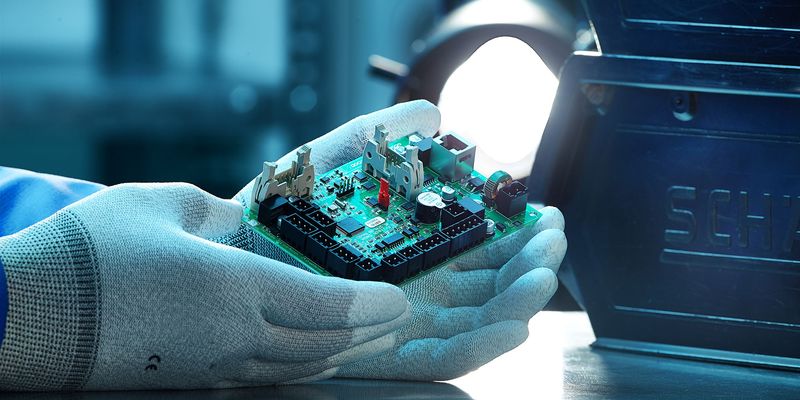
We aim at achieving a high-quality level for all assemblies at ESO. In order to achieve exceptionally high quality for some of our most demanding customers, we have introduced our own internal quality criteria of “Basic” and “Prime” assembly quality levels as opposed to referring to IPC 610 classes.
Order Processing and Technical Documentation
| Criteria | Basic | Prime |
|---|---|---|
| Digital Design | No | Yes |
Incoming and Material Preparation
| Criteria | Basic | Prime |
|---|---|---|
| Counting of Customer Parts (2) | No | Yes |
| Drying of PCB before Assembly (3) | Only Multilayer | All |
| Transportation in Cleanbox (3) | No | Yes |
Assembly
| Criteria | Basic | Prime |
|---|---|---|
| PCB Cleaning Before SMT Paste Print (5) | No | Yes |
| SMT Soldering Technology | Reflow or Vapor Phase | Vapor Phase with Vacuum Only |
| Filling unassembled PTH | Yes | No |
| Depanelization (6) | All Methods | Routing or Dremel Only |
| Washing | No | Yes |
| Drying after Washing | No | Yes |
Process Quality Checks
| Criteria | Basic | Prime |
|---|---|---|
| Approval Before SMT Soldering | 3rd Person | Quality Manager |
| Approval After SMT Soldering | 3rd Person | Quality Manager |
| Manufacturing Quality Sign-Off per Side | No | Quality Manager |
| Microscope Check of Polarity (7) | No | Yes |
| Approval After THT Soldering | No | Quality Manager |
| Final Quality Sign-off before Shipping | No | Quality Manager |
Technical Criteria
| Criteria | Basic | Prime |
|---|---|---|
| Side and End Overhang | 25% | 10% |
| Solder Balls | No | No |
| Flipped Components | Yes | No |
| Vertical THT PTH-fill | 75% | 100% |
| THT wetting | 360° | 360° |
| Pinholes, Blowholes | Only very small | No |
Outgoing Inspection
| Criteria | Basic | Prime |
|---|---|---|
| Inspection Depth | 10% | 100% |
| X-ray | 10% | Yes (BGA, QDN, Thermal, etc.) |
| Dust of Flux Residue | Yes | No |
Packaging and Shipping
| Criteria | Basic | Prime |
|---|---|---|
| Individual Packaging | Bubble Wrap | Shielding Bags |
| Packaging in Box | Basic | Extra Cushioned |
| Shipping | Standard or Express | Express Only |
| CofC | No | Yes |
Footnotes
- (1) We normally have to assume that the components in the customer’s BOM match the pad design of the PCB. In the design check process we manually check every BOM line to make sure there are no mistakes in the customer BOM which cause to incorrect packages and might cause production delays.
- (2) We normally have to rely on customers sending us the right quantity of customer provided parts and can not count parts when we receive them.
- (3) We normally only dry multilayer as well as rigid-flex PCB because the glue used to permanently connect the core with the prepregs or rigid to flex area is hygroscopic. Two layer PCBs should not have humidity in the base material.
- (4) We try to keep our shopfloor very clean at all times, however we are not in a cleanroom or medical environment and dust can be an issue. For our prime assemblies we only transport our assemblies in perfectly cleaned and closed boxes through the whole process. Foam mats are not used to transport assembled PCB to reduce dust load.
- (5) PCBs might have dust or milling residues, these are not necessarily problematic for the quality of the assembled PCB. We can clean the PCB with a Teknek Hand Roller. (6) Depanelization by shearing (perforated tabs) or scoring (v-cut) can cause mechanical stress to components on the PCB, this may lead to cracked capacitors. By using the automated routing machine or dremel tool this mechanical stress can be prevented. (7) We have a two-stage SMT inspection process. In the CAI inspection we check if all parts are assembled, all DNP parts are not assembled and if the polarity is correct. Solder quality and short circuits are checked in the microscope inspection. For prime product we also check the polarity under the microscope in addition.