

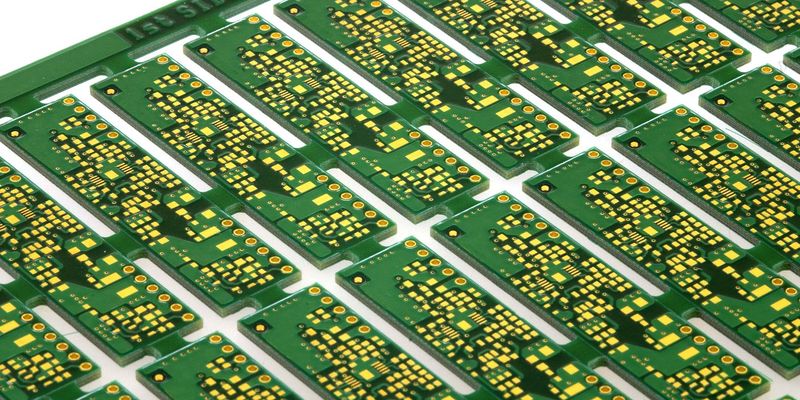
Printed Circuit Boards (PCBs) are normally assembled in panels that contain multiple boards within a frame. This is necessary to assemble in an automated and cost-efficient way. Depending on the product, the PCBs are separated from the panel (or depanelized) after the SMT or THT assembly process.
At ESO, there are numerous depanelization methods used depending on the technical requirements of the product.
The following table shows a comparison of the benefits and disadvantages, along with the speed and complexity of each method of depanelization.
| Method | Description | Benefits | Disadvantages | Speed and Complexity |
|---|---|---|---|---|
| Shearing (Hektor) | Panels with perforated tabs or catwalks on milled panels are separated with the "Hektor" machine | Typically used in a panel for uniquely shaped PCBs (e.g. PCBs that do not have straight edges) | Incorrect PCB and blade orientation may damage the PCB or components mechanically | Moderate |
| Cutting (Maestro) | Scored panels in FR4 and metal are separated with the "Maestro PCB separator". A scored PCB has a “V-cut” or groove at the edge of the boards | Allows for quick separation of PCBs with a single cut | Because of the mechanical strain of the blade running through the “V-cut”, the components close to the edge of the board or the board itself may be damaged. If the product requires minimal size tolerance, the PCB may not fit | Fast and cheap |
| Dremel | Rotary tools are used to separate PCBs manually. This requires specialized training and equipment to execute | The cutting knife is selected according to the PCB size | Requires an experienced worker and a well-ventilated station | Slow but with high precision |
| Routing Machine | A routing program is used to separate the PCBs precisely via a machine | Cuts to the exact separation point automatically and precisely | A program must be created and may be costly depending on the product | Depends on the contour of the PCB |