
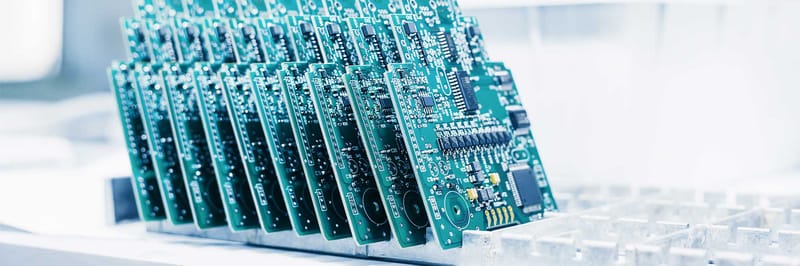
A conformal coating is a thin polymer film applied over a populated circuit board. It follows -- conforms to -- the contours of the board and its components, sealing the assembly against the environment while leaving it electrically functional. It is one of the most cost-effective reliability measures available to an electronics designer, and one of the easiest to specify badly.
The coating is a dielectric. Its entire purpose is to insulate and to exclude contamination, which means it must be kept off every surface that has to make electrical contact: connector pins, test points, switch contacts, mating surfaces and grounding points. This is worth stating plainly at the start, because it is the single most common misunderstanding we encounter.
What a conformal coating protects against
- Moisture, humidity and condensation
- Dust, fibres and airborne particulate
- Salt spray, fuels, solvents and other chemical exposure
- Corrosive atmospheres, including sulphur-bearing industrial air
- Surface contamination that would otherwise permit leakage currents, dendritic growth and electrochemical migration
By raising the effective surface insulation resistance between conductors, a coating also lets a design tolerate tighter creepage and clearance than an uncoated board would allow under IPC-2221 or IEC 60664 -- one of the reasons it appears in dense, high-voltage designs.
Automotive, medical, industrial control and aerospace hardware routinely require it. So does anything destined for an unconditioned enclosure.
The standards that govern it
Three documents do most of the work:
- IPC-CC-830 -- Qualification and Performance of Electrical Insulating Compound for Printed Wiring Assemblies. This is the material qualification and performance standard. It superseded the inactivated military specification MIL-I-46058C, which you will still see referenced on older drawings and datasheets.
- IPC-A-610 -- the visual acceptability standard. It defines coverage, thickness ranges and what counts as a defect on a coated assembly. IPC-CC-830 tells you whether the material is any good; IPC-A-610 tells you whether the coating job is.
- UL 94 for flammability class, and UL 746E for polymeric materials used on printed wiring boards.
Specify the material class and the standard together. A drawing that says only "conformal coat" leaves every meaningful decision to somebody else.
Material classes
Coatings are grouped by chemistry, and IPC and the older military specifications assign each a two-letter designation. The chemistry determines the thickness you get, the temperature the board will survive, how the coating cures, and -- crucially -- whether you will ever be able to rework the assembly underneath it.
| Class | Code | Dry film thickness | Temperature range | Cure | Rework |
|---|---|---|---|---|---|
| Acrylic | AR | 30--130 µm | up to ~125 °C | Solvent evaporation, air dry | Easy -- IPA or acetone |
| Urethane | UR | 30--130 µm | up to ~130 °C | Solvent, moisture or 2-part | Hard -- aggressive solvents |
| Silicone | SR | 50--210 µm | −65 to +200 °C | Moisture, heat or UV | Hard -- specialty solvents |
| Epoxy | ER | 30--130 µm | up to ~150 °C | Two-part or thermal | Very hard -- thermal or mechanical |
| Parylene | XY | 10--50 µm | ~−40 to +125 °C | Vapour deposition (CVD) | Very hard -- plasma, laser, abrasion |
| UV-curable | -- | Per product | up to ~125 °C | UV plus secondary cure | Hard -- micro-abrasion, scraping |
Thickness figures follow the ranges in IPC-A-610.
A few characteristics deserve elaboration.
Acrylic is the pragmatic choice. It goes on easily, cures at room temperature, and it comes off with isopropyl alcohol when you need to repair a board. It offers modest chemical and abrasion resistance in exchange.
Silicone is the answer to high temperature and to thermal cycling. It stays flexible, which matters when the coating spans components with very different coefficients of thermal expansion, and it resists UV and ozone. It is difficult to remove and it can inhibit the cure of other materials nearby.
Parylene is applied by chemical vapour deposition in a vacuum chamber, not by any liquid process. The polymer condenses onto every exposed surface as a pinhole-free film that penetrates under components. It is the highest-performance option by some margin, and it is essentially unreworkable. It is also the reason the four liquid application methods below are not a complete list of how coatings get onto boards.
UV-curable coatings are frequently mischaracterised, so be precise about them. They cure in seconds under a UV lamp to a hard, glossy, abrasion- and chemical-resistant film, and they are among the most difficult coatings to rework -- solvents are largely ineffective and removal means micro-abrasion, scraping or thermal methods. Their genuine weakness is geometric: UV light travels in straight lines, so the coating in the shadow of a tall component or under a connector never sees the lamp. Modern products solve this with a secondary moisture or thermal cure that finishes the shadowed regions over the following 24 to 72 hours. If you specify a UV coating, you must confirm that it has that secondary mechanism, or accept uncured material under your tall parts.
Application methods
Brush coating
The coating is applied by hand with a brush. Simple, low cost, no tooling, and completely flexible about which areas get covered. Thickness varies from stroke to stroke and the finish is cosmetically uneven.
Best suited to: prototypes, low volumes, rework and repair, and touch-up after a component has been replaced.
Spray coating
Applied from an aerosol can or a spray gun. Gives a smoother, more even film than a brush and remains economical at low volume. Every area that must stay uncoated has to be physically masked first, which is where the labour goes, and spray struggles to reach beneath densely packed or low-standoff components.
Best suited to: low to medium volumes on boards with accessible layouts and few keep-out areas.
Dip coating
The assembly is lowered into a bath of coating and withdrawn at a controlled rate. It is fast, and it delivers complete, uniform coverage of every unmasked surface on both sides of the board, including underneath components where spray cannot reach.
The corollary is that it coats everything that is not masked, on both sides. Masking must be thorough and leak-tight, and the process only makes sense for boards intended to be coated in full. Withdrawal rate governs film thickness, so it is a process parameter, not an afterthought.
Best suited to: higher volumes on designs where full two-sided coverage is intended.
Selective coating
A programmable robot moves a dispense head or an atomising nozzle over the board, applying coating only where the program says to. Keep-out areas are avoided by the machine rather than by masking tape, which removes the largest labour cost in the whole process and the largest source of variation.
It requires the board to be designed for it -- keep-out areas need enough clearance for the nozzle path, and very tall components can still shadow their neighbours -- and it requires programming time per board revision.
Best suited to: medium and high volumes, complex or densely populated assemblies, and any product where masking labour dominates the coating cost.
Vapour deposition
Reserved for parylene. The board goes into a vacuum chamber where the monomer polymerises directly onto every exposed surface. There is no masking tape that survives this process; areas that must stay clear are protected with dedicated masks and boots. It is a batch process with a long cycle time and a correspondingly high cost per board.
Materials we hold in stock
Our standard process uses two materials, chosen to cover the common cases rather than to be exhaustive. For anything outside them we source to the requirement.
- Peters Elpeguard. Elpeguard is a family of coatings from Lackwerke Peters in Kempen, Germany, spanning several chemistries -- acrylate grades such as SL 1800 and SL 1347, polyurethane grades such as SL 1301 ECO-FLZ, UV twin-cure grades in the DSL 1600 series, and silicone grades in the DSL 1700 series. It is worth naming the specific grade on your drawing rather than "Elpeguard", because the chemistries behave very differently. We apply these by brush for low-volume work, rework and repair.
- Solbi PRM-CT-UV, a UV-curable coating applied by dip, held for the small number of applications that specifically call for it. It is a high-cost material and we use it only where a customer requirement names it. As with any UV-cure product, the shadow-area behaviour described above applies.
If your product has an approved-materials list, send it to us with the assembly documentation. Substituting a coating chemistry is not a like-for-like swap.
Choosing a coating
- Environmental exposure. Condensing humidity, salt, chemicals or sustained heat above 125 °C each narrow the field quickly. Sustained high temperature points to silicone; aggressive chemicals point to urethane or epoxy; the harshest environments point to parylene.
- Rework expectation. If the assembly will ever need a component replaced in the field or in a repair depot, choose acrylic. Choosing epoxy or parylene is choosing to scrap the board instead.
- Production volume. Brush and spray at low volume; selective or dip once the masking labour outweighs the programming cost.
- Board density and standoff. Low-standoff components under which coating must flow, or must not flow, change the answer.
- Coating thickness. Thicker is not better. Excess coating over a large component pools, and pooled coating shrinks as it cures, pulling on the joints underneath.
Designing a board that can be coated
Most coating problems are designed in long before the board reaches us. The following save real money:
- Define keep-out areas explicitly in the assembly documentation -- connectors, test points, switches, mating surfaces, heat-sink contact areas, grounding points and anything with a press-fit. Do not leave the coating boundary to interpretation.
- Give keep-outs room. A masked area needs clearance for tape, a boot or a nozzle path. A test point 0.5 mm from a component body cannot be reliably protected.
- Group tall components together rather than scattering them, so they shadow each other rather than shadowing parts that need coating.
- Specify component standoff where coating must flow underneath, so material can wick in, wet out and cure without trapping solvent or forming a pool.
- Consider cleanliness first. A coating seals in whatever is under it. Flux residues and ionic contamination trapped beneath a coating cause exactly the corrosion and electrochemical migration the coating was bought to prevent -- see our article on CTI value and ionic cleanliness.
- Inspect to a standard. Reference IPC-A-610 for the acceptance criteria and IPC-CC-830 for the material, and state the required thickness range on the drawing.
Conformal coating is a straightforward process that rewards specificity. Tell us the environment, the rework expectation and the keep-out areas, and the material and method usually select themselves. If you are unsure which class suits your product, or you would like a design reviewed for coatability before you release it, our engineering team is happy to help.
Sources
- IPC-CC-830 -- Qualification and Performance of Electrical Insulating Compound for Printed Wiring Assemblies
- IPC-A-610 -- Acceptability of Electronic Assemblies
- IPC-2221 -- Generic Standard on Printed Board Design (creepage and clearance)
- IEC 60664 -- Insulation coordination for equipment within low-voltage supply systems
- UL 94 -- Tests for Flammability of Plastic Materials; UL 746E -- Polymeric Materials, Industrial Laminates
- MIL-I-46058C -- inactivated for new design, superseded by IPC-CC-830
- Lackwerke Peters GmbH + Co KG -- Elpeguard product family documentation