

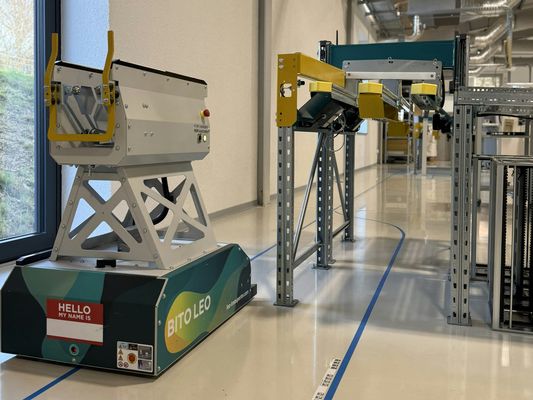
Most write-ups about automated guided vehicles count robots. Ours has one. A single BITO LEO locative runs at our Hennweiler plant, and the vehicle count is the least interesting number in the whole project. What made the difference was how many places that one vehicle can stop.
This article is about what an AGV actually does in an electronics factory, what determines whether it pays off, and one effect we did not plan for.
The transport problem nobody puts on a quotation
An SMT line is hungry in a way that does not show up on a routing sheet. It consumes component reels and feeders, and it produces finished panels, empty containers and packaging material that has to go somewhere. None of that is value-adding work, and all of it is somebody's walk across the shop floor.
Our material flow begins at incoming goods, which also serves as outgoing inspection, and then fans out to the machines and packaging stations. In BITO's assessment of our plant before the project, employees covered several kilometres per shift simply supplying the machines.
Distance is the obvious cost. It is not the expensive one. The expensive one is what people do to avoid walking:
- Every trip is an interruption. An operator who leaves a machine to fetch material is not running the machine.
- Because walking is expensive, people batch it. Nobody makes six trips when one big one will do.
- Batching means larger buffers at the line, because the next delivery is further away in time.
- Larger buffers mean shelving, and shelving means floor space.
Hold on to that chain. It is where the interesting result comes from.
One vehicle, many stations
In a system like LEO locative, the unit of capacity is not the vehicle. It is the transfer station.
The transporter runs a fixed route -- in our case a ring that goes around the entire company, so it passes essentially everywhere material is needed. The stations sit along that ring. Each one is a rack-mounted frame that hands a container to the vehicle or takes one from it using a spring-loaded towing mechanism, entirely mechanically, with no electronics in the handover itself. They come as single stations, and as double stations that drop off and pick up in the same pass.
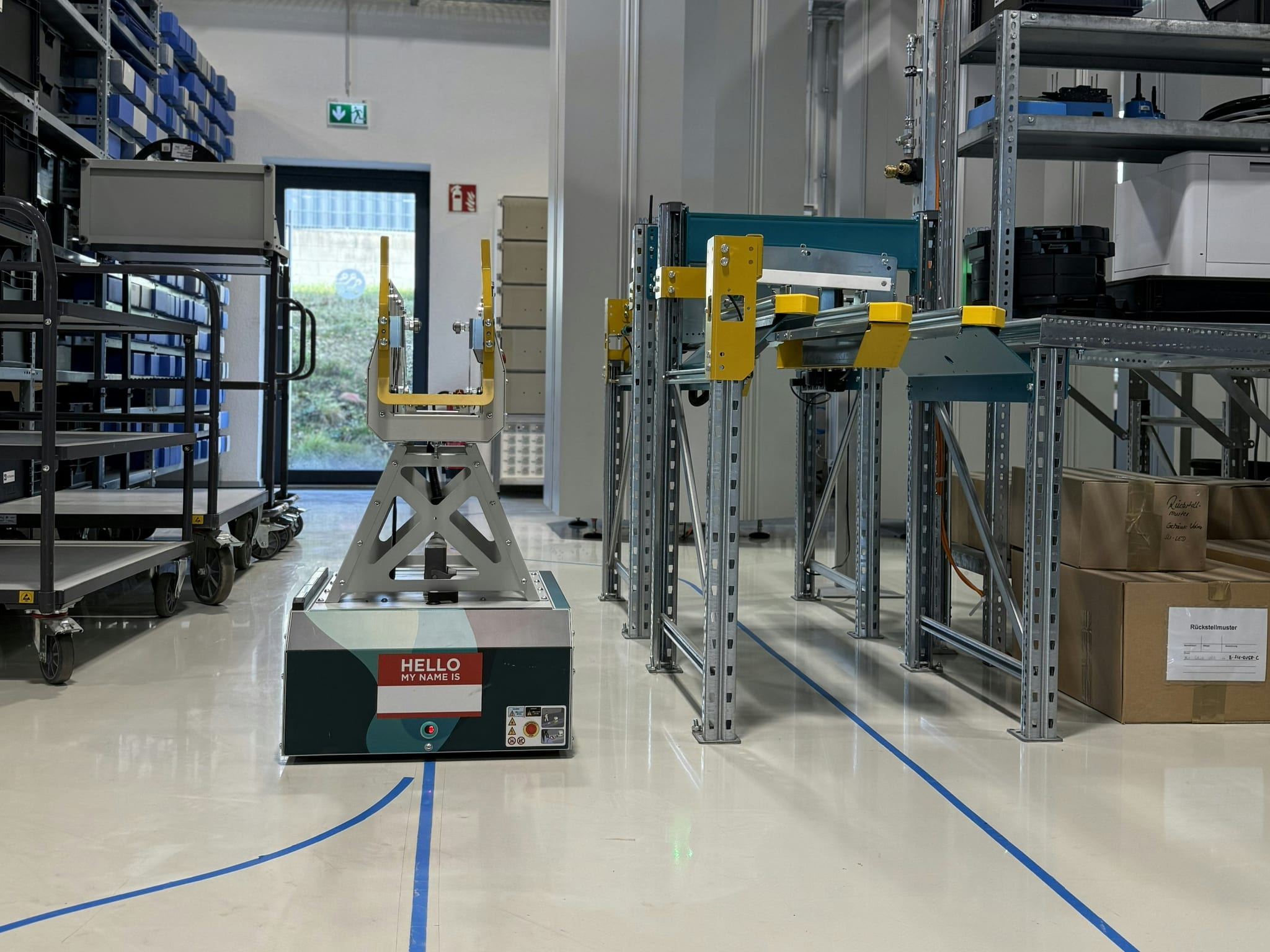
That distinction is the whole economics of the project. Adding a destination means adding a station, which is a frame and a bracket. Adding throughput means adding a vehicle, which is a machine. Most plants that conclude "AGVs are too expensive for us" have priced a fleet when what they needed was one vehicle and a generous number of stations.
A ring route helps here too. A vehicle shuttling point to point spends much of its life empty or waiting for a job. A vehicle circulating a loop is always on its way to the next station, and any station on the loop can hand it something. You need a second vehicle when the time to complete one lap becomes longer than the interval at which material is requested -- not before.
The effect we did not plan for: less shelving
Here is the part that surprised us.
Every transfer station holds a container. Multiply that by the number of stations around the ring and you have a substantial number of live buffer positions, each one sitting at the point where the material is actually used.
Those positions replaced static storage. We now need noticeably less shelf space than before, because the buffer moved out of the warehouse racking and onto the stations themselves.
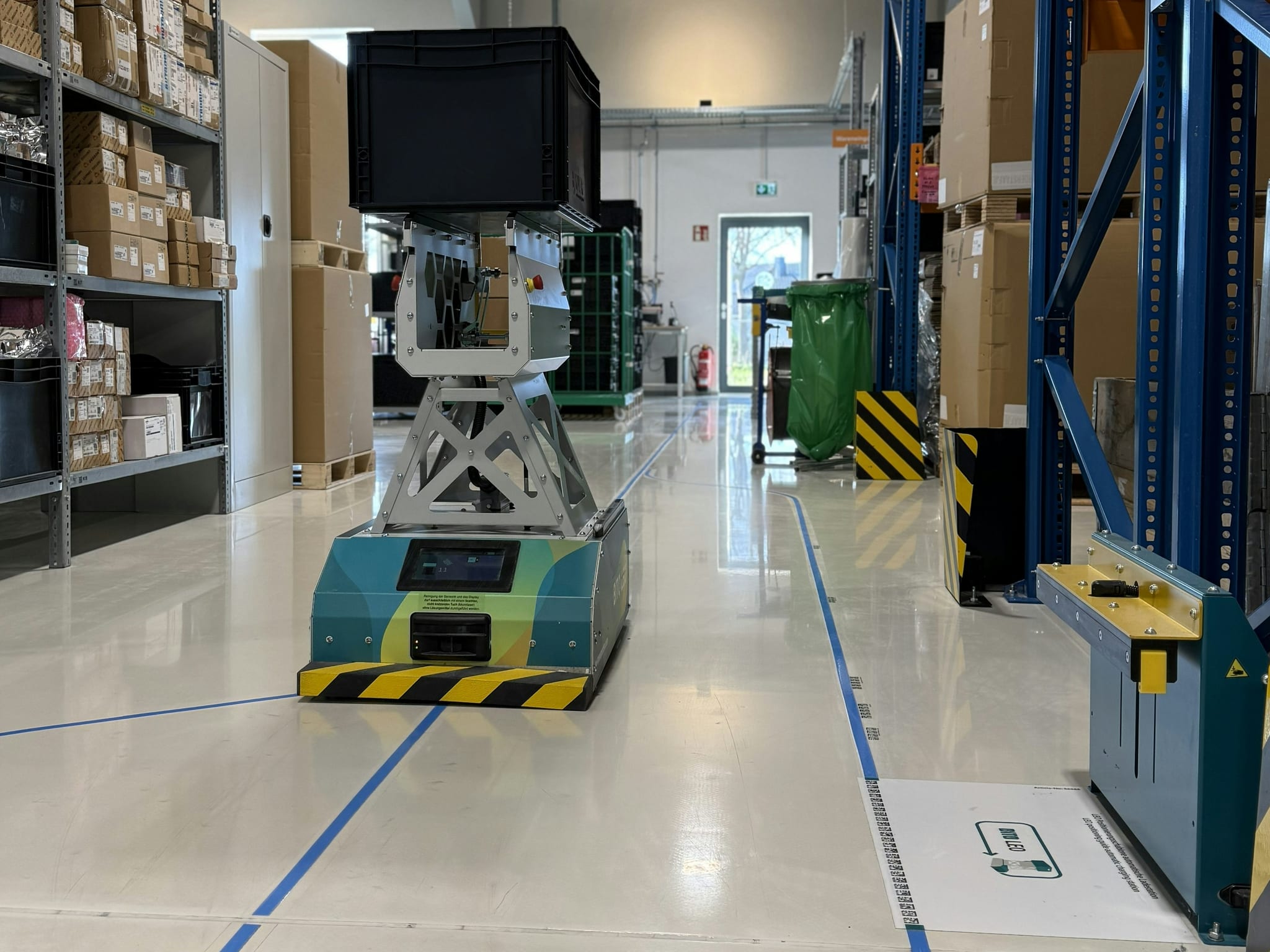
Go back to the chain from the first section and it makes sense. Shelving exists because material has to wait somewhere far from where it is needed. When transport becomes cheap and continuous, material can wait at the machine instead of in a rack, in the small quantity the machine will actually consume. The AGV did not just remove walking. It removed the reason for a chunk of the warehouse.
This only works if you are generous with stations. Specify too few and you keep every shelf you had, and you have added a robot on top. Count stations before you price the vehicle.
Standalone by design
The system navigates by markers placed beside the lane. Each marker carries five identical data matrix codes; LEO reads one and executes the corresponding command. Destinations and junction traffic are handled by a decentralised controller, so multiple vehicles do not collide at bottlenecks.
What it does not need is an IT connection. No MES integration, no ERP interface, no dependency on the plant WLAN. And we changed nothing in the building to install it: no floor works, no ceiling fixtures, no rerouting of aisles. Setup was genuinely straightforward, and the layout can be extended by us, without the supplier on site.
That is a deliberate trade-off, and it is worth stating plainly rather than selling it as a pure win. A standalone transport layer does not book stock. LEO moves a container; it does not know or record what is in it. We decided the transport layer does not need to know. That decision is what kept this a project measured in weeks instead of a year. If you need automated inventory booking at each handover, you are looking at a materially bigger and slower project, and you should plan it as one.
The supplier that became a customer
There is a detail here we like more than we probably should.
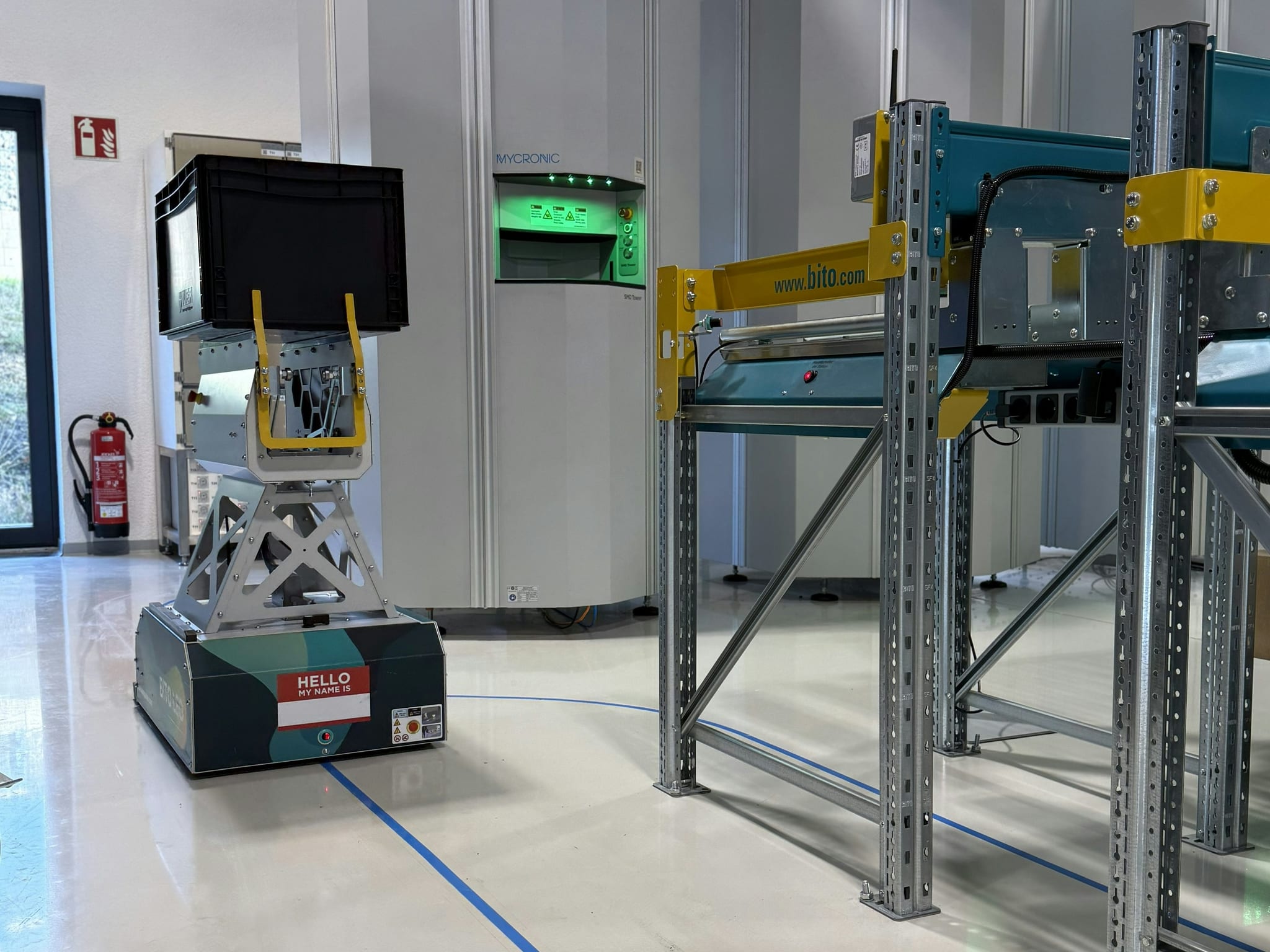
The electronics inside LEO vehicles are built at Newmatik. BITO is based in Rhineland-Palatinate, as we are, and the assemblies that drive their transporters come off our lines.
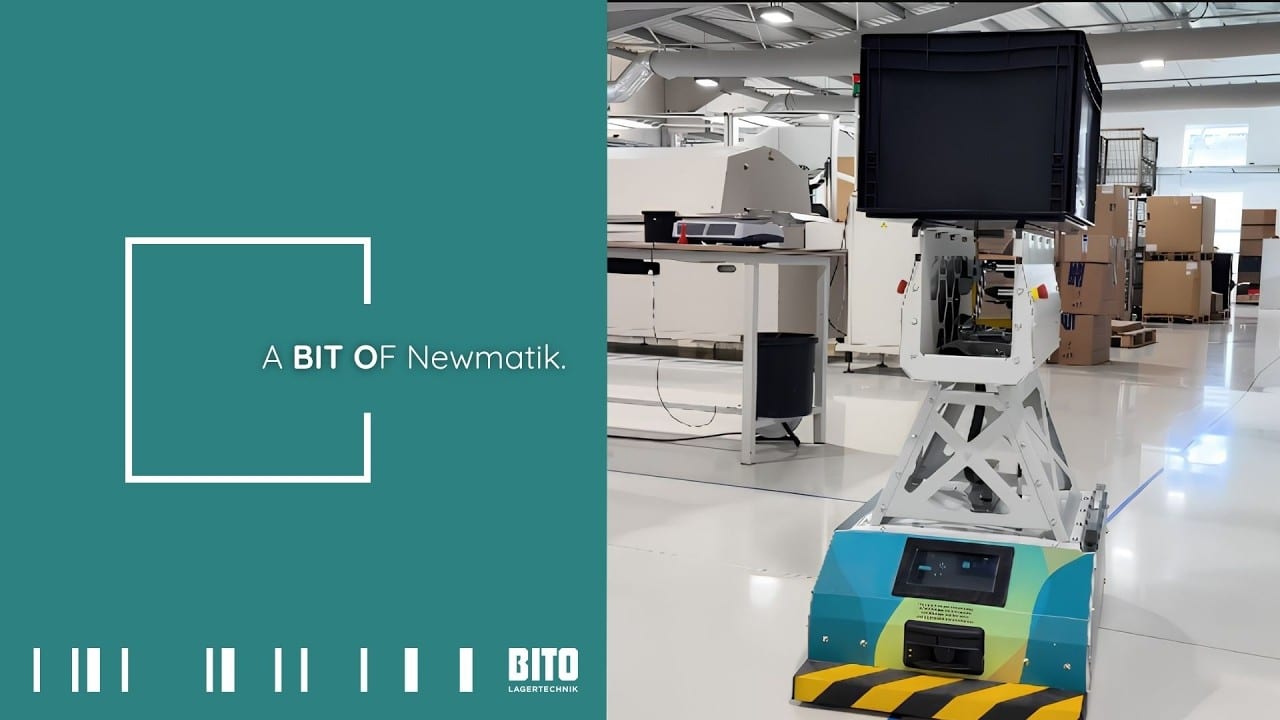
Then we bought one and put it on our own shop floor, where it now carries the material used to build those same assemblies. We use LEO to build LEO. In one project we went from being BITO's supplier to also being their customer, which is a fair summary of how manufacturing in this region actually works.
Is it worth it for a mid-sized manufacturer?
An AGV of this kind earns its place when the transport task is repetitive and the geography is stable. It does not when either of those is missing.
| Works well | Works badly |
|---|---|
| Routes that repeat every shift | A different route every day |
| Fixed pick-up and drop-off points | Ad-hoc destinations decided on the spot |
| Many small loads, up to 35 kg per container | Heavy, oversized or awkward loads |
| Flat, clean, stable floor layout | Layout that is rearranged every few months |
| Distances long enough that people batch trips | Everything already within a few steps |
Six questions worth answering before anyone quotes you a vehicle:
- Can you draw the loop on your floor plan? If you cannot draw it, the project is not ready. The route is the design; the robot is a consequence.
- How many stations, and where exactly? This is your real cost driver and your real capacity figure.
- What is in the containers, and what do they weigh? The payload ceiling is 35 kg. That is plenty for reels, feeders and assembled boards, and not enough for everything.
- Who fills and empties the containers? An AGV transports. It does not pick, count or inspect. If your bottleneck is picking, this is the wrong machine.
- What happens when it stops? The fallback has to be a person with a trolley, and the line must not care. Any system where a failed vehicle halts production has been designed wrong.
- Does the floor already work? Flat and clean, with sensible interaction between the vehicle and any forklift traffic.
What we would tell someone starting
Map the ring before you choose the vehicle. Budget for stations rather than robots. Expect the storage effect, and design for it deliberately instead of discovering it. And start with one vehicle -- a system you can extend yourself is worth more than a fleet you specified before you understood your own material flow.
The point of automating internal transport is not that a robot looks impressive on a factory tour. It is that the people who used to walk several kilometres a shift now spend that time on the machines, and a section of the warehouse turned out not to be necessary.
Photos and video: BITO-Lagertechnik, published with permission. The LEO locative and its transfer stations are BITO products; the plant shown is our factory in Hennweiler, Germany. BITO's own write-up of the project is here: BITO reference: Newmatik.